




By Brandon Martin
The state has been abuzz lately after Gov. Ralph Northam announced his support for the legalization of recreational marijuana.
Currently, Northam is working with lawmakers to finalize legislation on the issue in advance of the 2021 General Assembly session set to convene on Jan. 13.
“It’s time to legalize marijuana in Virginia,” Northam said. “Our Commonwealth has an opportunity to be the first state in the South to take this step, and we will lead with a focus on equity, public health, and public safety. I look forward to working with the General Assembly to get this right.”
As legislators debate the issue, local community members have differing opinions on the subject.
“What is done by legislative acts, we follow the law,” Henry County Sheriff Lane Perry said. “I don’t agree with it. I personally do not think that is a positive but what is handed down by the state, we will follow the laws and we will be professional.”
Perry said his personal opposition comes from underlying dangers that could be associated with marijuana.
“I think marijuana is very much a gateway drug and I think it starts people on the way to intoxicants where they are pursuing a high when that (marijuana) doesn’t fulfill an addiction anymore,” he said.
This is an opinion that Patrick County Sheriff Dan Smith also holds.
“The moral implications of legalizing marijuana far outweigh the legal implications,” he said. “We’re basically saying to an entire generation of kids that it’s okay to smoke pot in your parent’s backyard, and that is wrong in my opinion.”
Based on his 26 years in law enforcement, Smith said marijuana has a propensity to lead to hard drugs.
“In the thousands of hard drug distribution cases that I have been involved with over the years, marijuana use was always the catalyst that led to harder drug use” of substances such as methamphetamine, cocaine and heroin, Smith said. “The term gateway drug is entirely accurate.”
This term is disputed by proponents of recreational marijuana, however.
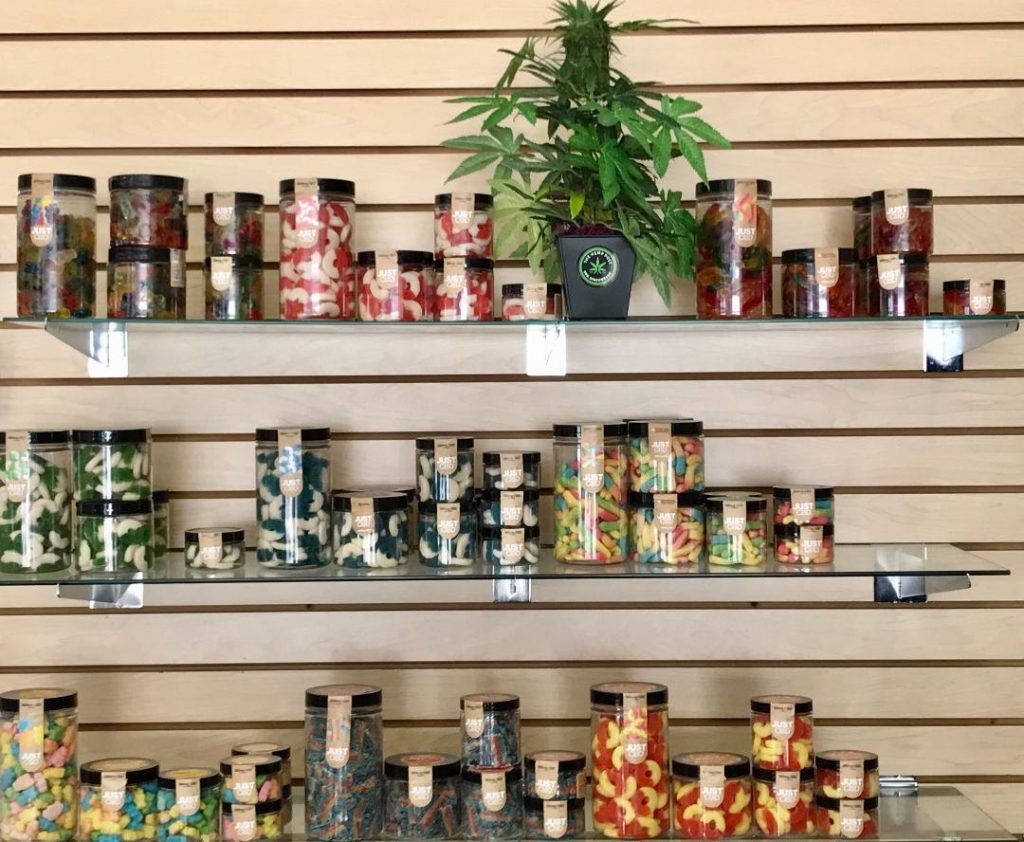
Cameron Post and his father have operated The Hemp Post on Virginia Avenue in Collinsville for a little more than a year, and he sees the issue as more complex.
“Marijuana can be a gateway drug. I’ve seen where people would start off smoking marijuana and when it wasn’t readily available, they would turn to other things. I don’t think it necessarily makes you want to do other drugs though,” Post said.
He added that the concept of a gateway drug is often used too broadly and often only used exclusively as a talking point against marijuana.
“In that sense, anything can be a gateway drug,” Post said. “Alcohol or nicotine could be considered a gateway drug if you frame the argument in the right way.There is also the other side where many people have credited marijuana for getting them off harder drugs.”
Post noted recent studies in which scientists found that marijuana could be an “off ramp” from opioids instead of a gateway.
For example, a 2016 study conducted at the University of Michigan found that “patients using medical marijuana to control chronic pain reported a 64 percent reduction in their use of more traditional prescription pain medications known as opioids.”
“We’re in the midst of an opioid epidemic and we need to figure out what to do about it,” said Kevin Boehnke, lead author of the study and doctoral student in the School of Public Health’s Department of Environmental Health Sciences. “I’m hoping our research continues a conversation of cannabis as a potential alternative for opioids.”
A 2018 study conducted by the University of Minnesota also had similar results.
A total of 353 patients in the study self-reported taking opioid medications before using medical marijuana. Approximately 63 percent of those patients reduced or eliminated opioid use after six months, according to the study.
Additionally, the health care practitioner survey found that 58 percent of patients who were on other pain medications were able to reduce their use of these medications when they started using medical marijuana.
Even with legalized recreational marijuana, Perry said he still sees a market for drug dealers.
“The other part of it is that you’ll still have people that are selling marijuana and there are instances where marijuana has been laced with other things,” Perry said. “Drug dealers are unethical and what they want are customers. There are instances where marijuana is laced with fentanyl and other products, like cocaine, because they want to see an addiction and they want to see customers coming for it.”
The biggest competition for drug dealers would be those with distribution lines already in place, like Post. Not only is he looking forward to that reality, it also is one that he has been planning for from the beginning.
“We would definitely” start selling recreational marijuana upon legalization, he said. “That has always been the plan to graduate from CBD (cannabidiol) to every kind of cannabis product. We’ve already kind of got the system in place. I would just split the product half and half with equal parts CBD and THC (tetrahydrocannabinol) products. We’d have to make sure that they were separated for customers, obviously.”
In conjunction with the 2018 Farm Bill, Virginia laws were changed to recognize hemp as an agricultural commodity, allowing production of the herb without legal consequences provided all federal guidelines are met.
Both hemp and marijuana come from the same plant-Cannabis Sativa L. By altering growing conditions, the chemistry of the plant can be changed, with hemp demonstrating higher amounts of CBD and trace amounts of THC as opposed to marijuana that contains far more THC.
“Hemp is cannabis but it’s below a certain amount of THC so it’s not psychoactive and it can’t change the way you think,” Post said, adding that the legal threshold for THC in hemp products is 0.3 percent.
“The farmers are currently responsible for ensuring the hemp is within regulation standards,” he said. “They have to test their crops before they put them out. There are private labs that they send them to.”
Post said there can be benefits to differing amounts of CBD and THC which are largely determined by the individual using the product.
“It really depends on the person. You can’t really say that products with more CBD or THC are better than the other,” he said. “I’ve had people tell me that CBD does better for them than THC does. For a normal dosage, I tell people to start with 10 milligrams and just work their way up from there. Some people need closer to 50 or 100 milligrams but like the preference for CBD or THC, it’s different for everyone.”
Post said that his endorsement of the products isn’t just for business either. He has personally seen the benefits of cannabis.
“I started using CBD for my anxiety,” he said. “I’ve been taking the gummies for a little over a year and it really turned me around. I never thought that I’d get to the point that I’m at now. It really made me fall in love with it.”

While legalized marijuana is considered good news to Post, he does have concerns about how the law will be introduced.
“I’m very worried right now that they are just going to offer one license per county or something like that,” he said. “Then there are going to be $100,000 licenses. It would be impossible for us to do it. It would put us out of business because they are going to go to those dispensaries looking for CBD products once they start drawing more attention from the products higher in THC.”
Post said licenses are not required for retailers to sell just hemp if it has been “finished, dried and cured.”
Like Perry, Post said he has concerns about who is and isn’t allowed to sell cannabis products.
“I’m all for regulations because it keeps people from who shouldn’t be selling because they aren’t knowledgeable. Especially when you are talking about THC. It does have the power to make people have panic attacks or something like that,” Post said. “I already treat my products like they are regulated. We are very meticulous about everything we do.”
Post said that distributors should have due diligence when selling products to customers.
“My biggest problem is people not warning people about their dosages. Someone who has never tried cannabis at all before, maybe you shouldn’t sell them a chocolate bar with 100 milligrams in it,” he said. “I’d really like to see people who are truly educated and can tell people the risks involved. I treat it like its food. Everything must be cleaned, whereas some people think they can just grab it with their hands. You wouldn’t do stuff like that if you were at something like a buffet.”
With the possibility of legalization and the introduction of regulations, the burden of enforcement would shift more to the Food and Drug Administration. Not much else would change, according to local law enforcement.
“From the discussions that I’ve heard on the subject, those already serving time for marijuana convictions will finish out that sentence,” Martinsville Sheriff Steve Draper said. “The biggest change will be for law enforcement on the streets and the process before the suspect gets to the jail.”
Should the Commonwealth decide to release inmates serving time for marijuana-related charges, Draper doesn’t see a huge dip in Martinsville’s jail population.
“We don’t have that many that are serving time for simple possession charges. Overall, I don’t see it having a large impact on our jail population.”
Likewise, Smith said that marijuana possession hasn’t been a big issue for law enforcement over the years.
“I have never seen anyone jailed for misdemeanor possession of marijuana,” he said. “Marijuana legalization proponents always use this as one of their points for legalization. That is a myth. In fact, in Virginia, simple underage possession of alcohol carries a much more severe punishment than does simple marijuana possession.”
Northam signed legislation earlier this year to decriminalize simple marijuana possession in Virginia. The legislation also required the Secretaries of Agriculture and Forestry, Finance, Health and Human Resources, and Public Safety and Homeland Security to convene a Virginia Marijuana Legalization Work Group to study the impact on the Commonwealth of legalizing the sale and personal use of marijuana.
The report was released on Nov. 30. The findings can be found at: https://www.governor.virginia.gov/media/governorvirginiagov/governor-of-virginia/pdf/Final-Report-on-Marijuana-Legalization-11.30.20.pdf.


